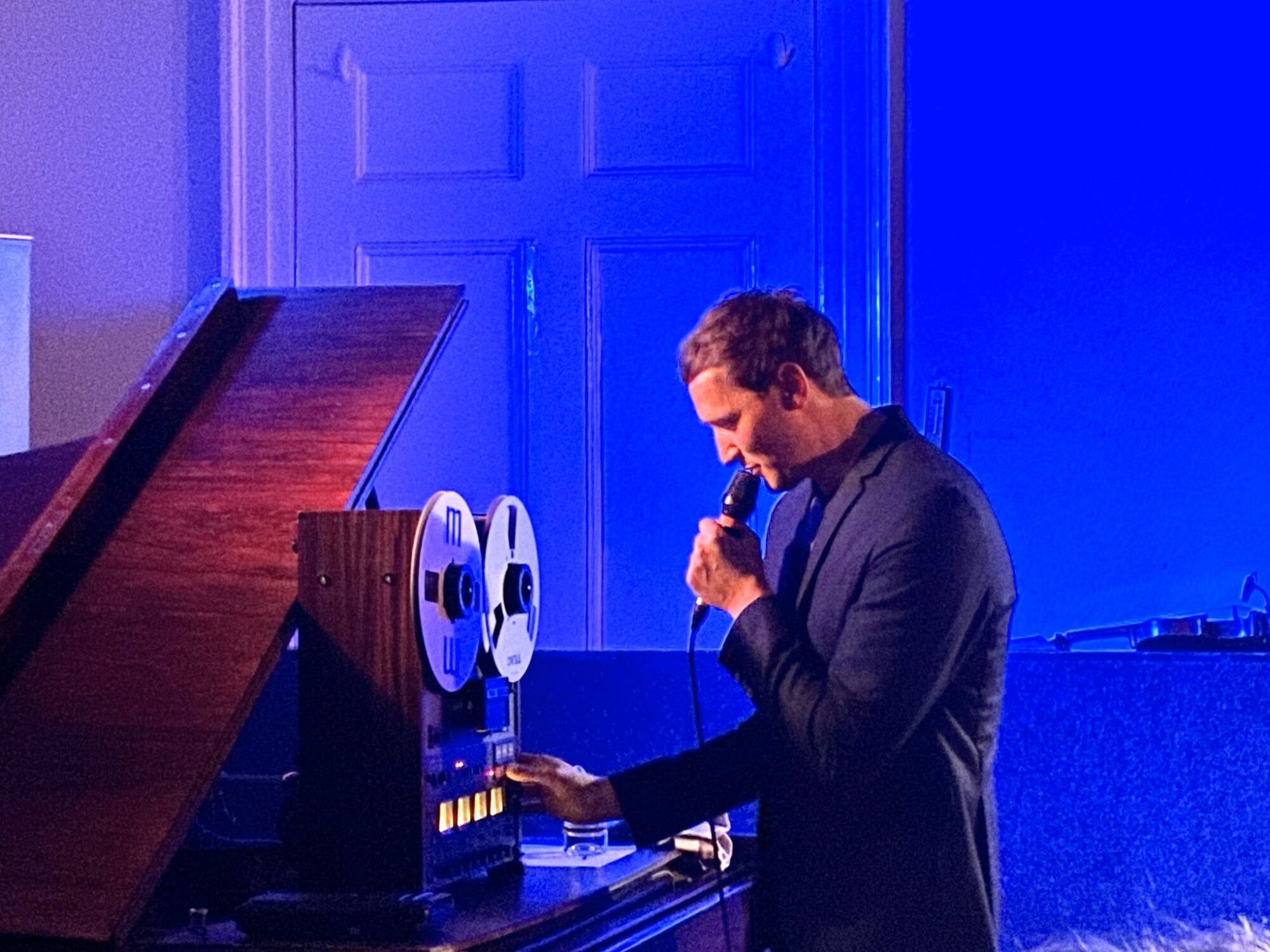
The Unitarian Church in Brighton’s North Laine is a small, square space with high white walls. Somewhat bare and stark, it almost demands that you cast your gaze upwards, and when you do, you almost expect to find a starlit sky rather than a ceiling. Halfway through a sell-out concert, Erland Cooper has turned off all of the lights and we’re sitting in near-darkness, listening to music so quiet “that you’ll be able to hear your stomachs rumble”, and imagining sunrise over Orkney as the sound gradually builds and the lights gradually return. And I have tears running down my cheeks.
It is a truly magical evening. A natural collaborator, Cooper’s charming nervousness and generosity of spirit create an irresistible energy. We would’ve been satisfied with hearing a live performance of his exquisite evocations of Orkney landscapes and wildlife, but we become part of the collaboration ourselves, and an openness to the wonder of it all is our contribution. The absence of a stage breaks down the barrier further; he bounds enthusiastically out into the central aisle at one point and has to apologise to a woman in the third row for standing on her toes. There are jokes, laughter. “It’s just music!” he shouts giddily after a mistake. A small community is built in less than an hour.
He’s aided in his stated mission to take us on a journey back to his home, back to Orkney, by four exquisite players. The distance between that idea seeming rather trite and it seeming, well, like a memory to be cherished for a lifetime is in their ability to stretch each movement to its very fingertips, to make each phrase and each note matter utterly. The grain of wood, the texture of rippled sand, the sound of waves on shingle; there is so much detail and yet so little fuss. The world has plenty of vaguely evocative music, stuff that doesn’t take any chances; here, we’re reminded of quite how powerful evocation can be, of how simple and intimate it can seem.
I close my eyes and I’m sitting on my favourite bench in a Cornish cove, with the waves crashing onto the rocks below, with the gulls flying home before nightfall, with a book forgotten by my side.
We have a sense, I think, that music ought to do more than that, that it should be clever and curious and complicated. That it should be used to interrogate the world rather than merely – merely! – reflect its glories. And so it should, some of the time. But we’ve lost something, perhaps, to that idea. If the sound of a couple of violins, a cello, a piano and a soprano can connect with parts of ourselves that are often entirely out of reach, beyond our everyday existences, then is that not in itself something profound? And if it isn’t, should we give a flying toss?
Cooper’s music is born of the landscape, and of a particular place, but it comes to life in our collective imagination. It might therefore be just a dream, an idyll, a fiction. In reality, there’s probably someone in Stromness swearing at a malfunctioning broadband router right now. But it is a dream in which there is peace, serenity, overwhelming joy, and in which those things are shared generously. We’ve built whole belief systems on that in the past. We can afford it a little room now, surely. Now more than ever, possibly.
At the evening’s end, the audience rises to its feet in a state of what can only be described as euphoria. The noise of our appreciation seems wild and untethered after so much delicacy and poise. The orchestrator of it all appears a little shocked at the response, and thrilled, bounding out of the room with a delirious leap over the monitors after taking a bow with his quartet. We dry our eyes and gather our things, and return to the outside world, and see it all anew.
Ian Grant