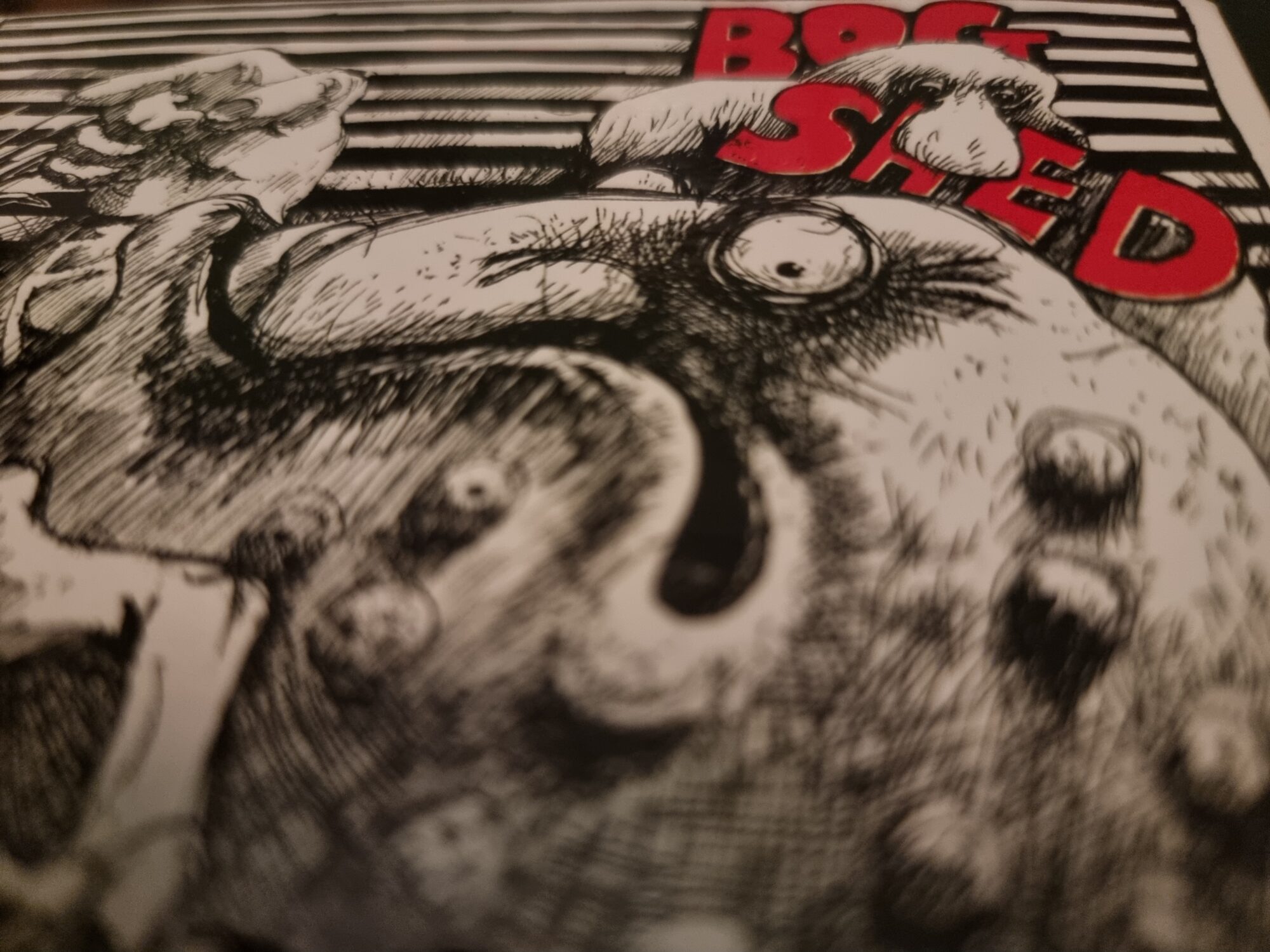
Yes, the name. Yes. Unavoidable, so let’s get it over with. No band has ever conquered the world, or even small parts of it, with a name like ‘Bogshed’. Aware of that obstacle themselves, there’s an entertaining anecdote, re-told in the notes accompanying a splendid ‘Bog-set’ reissue of their back catalogue on CD, in which the foursome head to the pub to thrash out a better moniker. After many hours and many pints, they manage nothing better than ‘Tarty Lad’. They couldn’t help themselves, that’s the thing.
And they were widely reviled for it, more’s the pity. I do wonder, in passing, if they’d have been quite so thoroughly sneered at if they’d hailed from somewhere less unfashionable (then, if not now) than Hebden Bridge, but they were frequently held up as a scapegoat for all that was wrong with mid-eighties indie: a miserable lack of ambition dressed up as bold independence, a dearth of skill masquerading as an artistic choice. They weren’t helped in that by John Peel, who despite being an ardent admirer of the band, hung the word “shambling” around their necks. History insists on telling us that they’d have been long forgotten were it not for an appearance on the NME’s C86 cassette.
None of that seems terribly fair, really. Along with Peel, and regardless of the C86 legend, and in spite of there now only being one member still alive, some of us have continued to remember Bogshed with huge fondness as the years have passed. They were an oddity then, they’re an oddity now.
What they weren’t, however, was wilfully obscure: the mis-labelling of their sound seems particularly frustrating given that, actually, it was remarkably easy to grasp if you bothered to try. Repetitive to the point of making the Fall sound like a free-jazz experiment, the beauty of the perfect Bogshed song is in establishing a simple and entirely logical riff, often led by Mike Bryson’s chunky bass and then filled in with Mark McQuaid’s spindly guitar before Tris King’s drums pin it all to the floor, and then not changing it very much at all for three minutes. If you don’t like the first ten seconds, there’s nothing for you here. If, on the other hand, those seconds get your foot a-tapping, you’re in for a right old treat, my friend.
Pretty much every Bogshed song is a joyous interlocking of those functional drum-bass-guitar parts, a firm-but-fun rhythm section which merrily barrels along underneath Phil Hartley’s vocals. Those vocals are bold, sometimes squawky; they’re distinguished from the post-punk crowd by a vague air of vaudeville, a whiff of end-of-the-pier entertainment. Even at his shoutiest, you knew that Hartley could be a crooner if he felt so inclined. The lyrics were odd, full of curious characters and surreal references, nostalgic and a bit parochial and occasionally somewhat bawdy, always loaded with Hartley’s personality. Even when you didn’t know what on earth he was banging on about, there was much to enjoy.
Viewed from the right angle, ignoring the warts and the boils, their essential jauntiness, their geniality, was inescapable. There are very few songs in their catalogue which won’t leave you feeling just a little merrier than when they began. Bogshed wrote pop songs for singing in the shower, played them as if people would shake a leg on the dancefloor. Not their fault – name aside – if nobody did either.
Of the box set contents, the disk of Peel sessions is of particular academic interest. As so often, the Maida Vale recordings appear to capture the band as they actually wanted to sound; the rest of their output captures how they could afford to sound. There must be hundreds of bands of whom that’s true. The first session, from 1985, finds a band clearly indebted to the muscular sound of the Membranes, on whose label they released a clattering first EP, also included; each subsequent session refines it just a little, fencing off their own patch amid a scene crowded with potential rivals. The different elements become clearer, the intentions less febrile.
Elsewhere, the first album, “Step On It”, continues to be a personal favourite, even if its production only seems to have got thinner over the years. Even the cheapest studio can’t suck the life out of these wonderful songs entirely, though: the scurrying absurdity of “Fastest Legs”, the preposterous glam strut of “Mechanical Nun”, the seesaw saaandwiiich-baar lurch of “Adventure Of Dog”. A particular soft spot has always been occupied by “Tommy Steele Record”, with its gentle trundling bassline and nostalgic tales of chip papers and childhood bed times; no other band of that era would’ve come up with something so unapologetically warm, so lacking in devilment. It’s just a charming song, and it appears to aspire no higher (or lower).
“Brutal”, its 1987 follow-up, broadens the palette considerably, but too late to win the wider attention it deserved. There are moments of genuine darkness; there’s a punkish anger at play too; Hartley has diversified his range of accents; the differences of opinion that’d make it their last record are pretty easy to spot. And yet there’s still a lightness too: “Loaf” releases Hartley’s inner crooner to curiously touching effect, “No To Lemon Mash” is knowingly and gleefully ridiculous even by their standards. When they stick with the tried and tested formula, they’ve rarely been better: “Excellent Girl” is a riotous hoedown of a song, while album opener “Raise The Girl”, thrust forward by a relentless chin-jutting riff which just gets more and more insistent for four minutes, would surely have been an indie disco staple if it’d belonged to a cooler band.
They never were that band, though. When push came to shove, I’m not sure that they really wanted to be. Not enough, anyway. All four of them came up with that name, none of the four came up with something more sensible to replace it. They were Bogshed, they lived in a cottage on a hillside, they made a jovial racket that you’d never mistake for anyone else. If you succumbed to their charms, you took them warts and boils and all.
Ian Grant