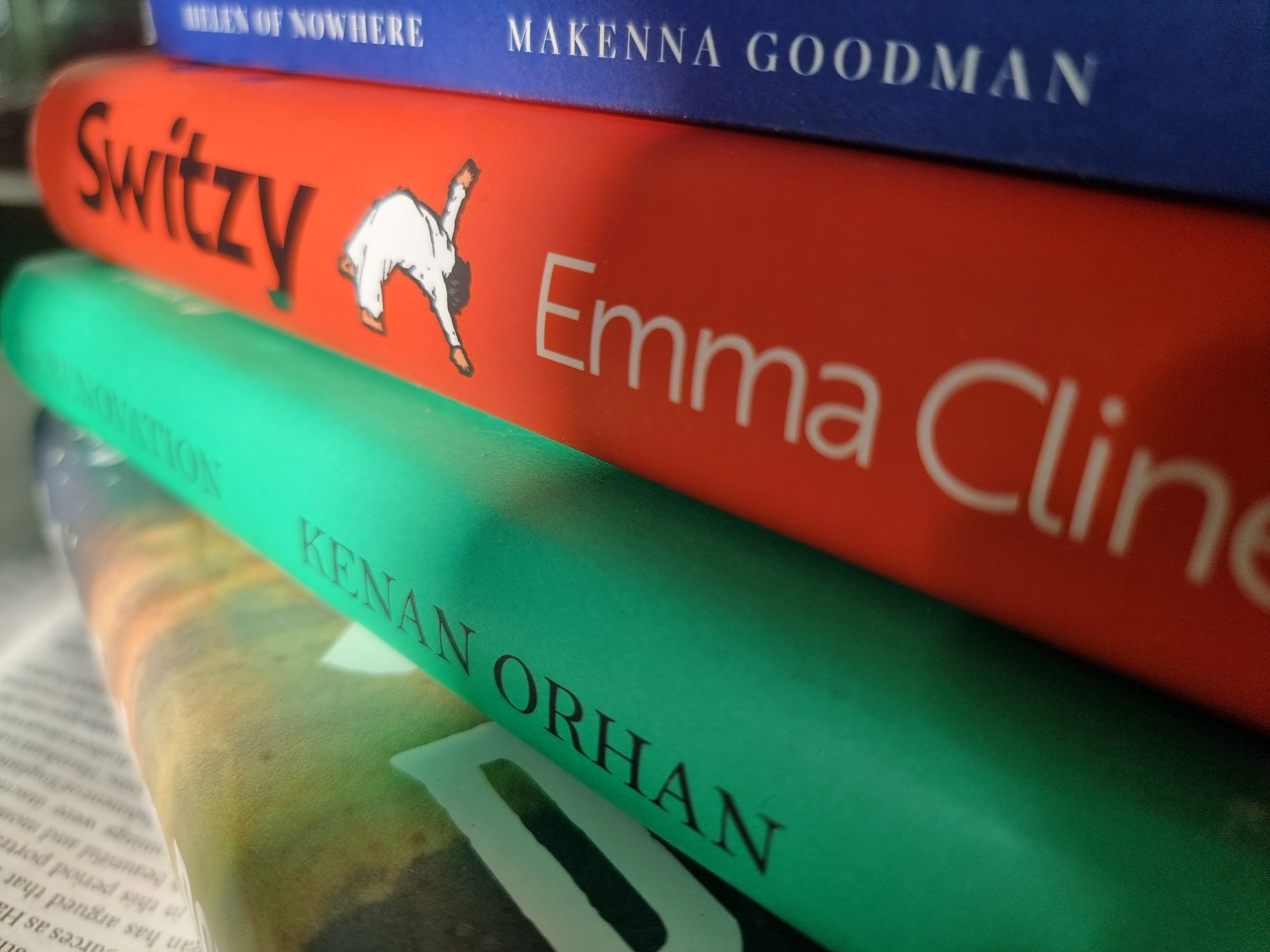
I try to read the Booker Prize longlist every year, have done for a while. Clever people can be sniffy about literary prizes, but unless you want to keep following the same old well-worn path – if you liked that, you’ll like this – then you have to base your speculative selections around something. I spent too long in my forties reading within my comfort zone, mainly flinty novels by Celtic blokes with a lot of Beckett on their bookshelves, and I needed something to get out of that rut. And I’m not sociable enough for book groups.
Anyway, let’s start with the seven on the longlist that didn’t make it through to the final six…
Gwendoline Riley – The Palm House
As a Riley enthusiast, this was the only novel that I’d already read prior to the announcement of the longlist. It’s fair to say that her work isn’t everyone’s cup of tea; not everyone likes their cuppa doused with lemon juice, after all. No, you may not have a sugar lump. It’s also true that she operates in a small space, a pocket of domestic fiction in which very similar characters, particularly insufferable mothers, recur across novels and very little actually happens in the way of a plot.
The Palm House doesn’t exactly break that mould, but it allows a certain amount of warmth to seep in. Several Riley novels read – delightfully – as if they’re calculated acts of revenge against selected family members and/or former partners; she can be an absolutely vicious caricaturist. Here, the reader is allowed to develop some affection for a couple of the characters, past trauma highlighting their humanity, and the novel’s resolution is decisively kind rather than cruel.
Crucially, though, Riley remains unmatched in depicting a particular type of embittered obstinacy and the difficult conversations in which it results; she does polite discordance and passive aggression and entrenched disappointment like nobody else. I’ve no idea if The Palm House is her best novel; it seems pointless to choose when they’re all so much of a piece. I’m delighted to see her receive a bit of attention, anyway.
Chloe Aridjis – The Shadow of the Object
One of three genuinely odd, genuinely charming novels on the longlist. The failure of any of them to make the cut for the final six reinforces the value of reading the full thirteen.
The centre point of this tale is Wilhelmina, who’s dying of pneumonia in a Mexican hospital as she forms an initially bad-tempered friendship with Flora, on a visit home from London. Wilhelmina is alive for barely a third of the novel, but her cantankerous shadow looms and flickers over the rest of it, particularly in the form of an obsession with magic lanterns and the tales their hand-painted slides can tell.
It’s a delightful, delicate novel, blurring the edges of perception and memory to the point where it almost becomes fable in places. The sort of book you file away on the shelves to be re-read at some point, aware that there are things you’ve only glimpsed out of the corner of your eye.
Makenna Goodman – Helen of Nowhere
As you’d expect from something with the distinctive blue cover of Fitzcarraldo, this is comfortably the most left-field novel on the list. It takes the form of a conversation between an apparently disgraced, belligerently outdated university professor and the real estate agent showing him around a house out in the sticks.
Much of the time, you’re only hearing one side of the conversation, effectively a monologue with pauses, an overheard telephone call. It’s a device which has a kind of stagey, wooden quality to it, initially off-putting but gradually creating a rather pleasing sense of curious detachment. From there, it all gets a bit weird, and you end up with a novel that’s all lumps and corners, deliberately and joyously misshapen.
(As an aside, there’s an awful lot of academia on this list. A whole truckload of lectures and seminars and students and professors and campuses and so on. I do worry that the desire not to offend anyone, to be accused of appropriation, by attempting to use a combination of empathy and imagination to build a bridge to their experience is leading to a redefinition of what fiction actually is and what it can do. There’s still some fun in auto-fiction, as Gwendoline Riley demonstrates, and clearly some security in writing about what you know, but if all novels are about novelists, or based on novelists’ worlds before they became novelists, we’ve lost the most valuable part of the artform: its ability to conjure up other lives, ideas, worlds. And really, what’s the point then, eh?)
Kenan Orhan – The Renovation
The last, and to my mind the best, of the oddities, in which a Turkish woman exiled in Italy finds that the ensuite bathroom she’s had built is actually a prison cell, a portal back to the oppression of her native land. Her father is disappearing into dementia, her husband is disappearing from her marriage, her country is in turmoil, and the whole construction of the novel barely holds together, even the language sometimes creaking and jarring as if under stress.
The effect is quite magnificent. It superbly blends the personal and the political, painful memories of flight from Erdogan’s Turkey in a tangled wrestle with an ache for the familiarity of home. The prison cell becomes a refuge, a way of connecting with a past life, but also a reminder of how much that longing is fuelled by nostalgic romanticisation. I found it very moving.
Djamel White – All Them Dogs
Given the current trend for regionally-representative, Top Boy-derivative gangsta dramas on telly – a kind of underworld devolution process, every city to get its own six-part series, very much part of Burnham’s new vision for Britain – it’s tempting to dismiss this squalid tale of Irish ne’er-do-wells as another one off the production line, adaptation deal pending. And then I remember just how many printed pages have been devoted to middle class people and their difficult relationships and well-to-do people and their difficult relationships, and I conclude that there’s ample room for more ne’er-do-wells yet.
And it’s very good, this. There’s a gay love story at its core, but it doesn’t depend on that element of novelty for its impact. Instead, it gets right under the skin of its characters, right into the dirt of their lives, and I found that the urgency of the unfolding, and inevitably disastrous, storyline was matched by my eagerness to tear through it to the end.
Missouri Williams – The Vivisectors
“There is a savage rush of description and dissection happening throughout” – The Guardian
“…uses the devices by which fiction generates meaning – allegory, metaphor, existential inquiry – yet it frustrates every attempt to make sense of them. The result is grim, energetic, exasperating: a knot of fertile, hyper-literate ideas that strangle one another” – London Review of Books
Well, now. For obvious reasons, there’s a lot of potential for this sort of thing right now: personal drama that’s literally swamped by some kind of incoming flood, ordinary lives drowning in watery metaphor. Julia Armfield has proved herself particularly marvellous at it, Sophie Mackintosh too. I approached this with some enthusiasm, therefore.
I’m aware that it has received much praise for its wild swirl of ideas. See above. Let us acknowledge that and move on, for it will not be receiving any of that praise here: I found it effing intolerable. It seems to me that the Guardian’s “savage rush” and the LRB’s “knot of…ideas” can, if viewed from another angle, look an awful lot like an author desperately chucking stuff at the wall to see if any of it sticks.
Repeatedly, the narrative arrives at a Great Big Subject that might be Explored In Further Detail and could even become an Overarching Theme – freedom of speech! abuse of power! class privilege! climate breakdown! identity politics! – only to thrust it in your face, wave it around a bit like you’re a bored cat and it’s a bright feathery toy, and then lob it out of the window before you can pounce. It is, as described, exasperating. The reviews suggest that this is somehow a novel about everything at once, about modern overwhelm, about nihilism and chaos. I suggest to you that it’s actually a novel about nothing much at all.
Emma Cline – Switzy
This, my friends, is the one that got away. Quite what the judging panel thought they were doing in culling it before the shortlist is a complete mystery; I’d love to have been party to that discussion. All of this is subjective, of course, but you know…what the actual…?
The point about Switzy is not that it dives headfirst into an extremely difficult subject: we follow a wealthy American businessman as he squares off his life on a one-way trip to an assisted dying facility in Switzerland, his mind increasingly uncertain as Alzheimer’s takes hold. The point about Switzy is that it does all of that in a way that’s almost weightless, that’s constantly flecked with light, with humour, with candour. Bleakness, sadness, regrets, humiliations…they’re all here, but they’re never alone, never the only flavour.
It’s not written in the first person but it might as well be: we see everything through David’s eyes, understand only fractionally more than he does. The effect is utterly disorientating, yes, but not without its moments of fun; social norms are often restrictive, abandoning them liberating, failing to understand them comic. It makes you wonder about how complete your own mind is, how long you have before you can’t see past its own blank spaces. David’s quite a bit of a wanker too, frankly; no elegaic mourning of a saint, this.
It’s brilliant. A feat of writing, a bit of a miracle, easily the best thing here. You should read it.
And so, to the shortlist. Switzy aside, it’s hard to make an emphatic case that any of the other culled novels should be here: too many quirks, too many oddities, not quite right for life in the spotlight. However, it’s also impossible to escape the feeling that the shortlist is safe, predictable, lacking in surprises. I love the longlist, I do not love the shortlist. But ho hum, here we go…
Elizabeth Strout – The Things We Never Say
I’ve read three or four of Elizabeth Strout’s novels before, with mixed results. Part of the problem, I think, is in her use of the same characters across multiple novels; I’ve had the somewhat alienating sense of arriving at a party to discover that everyone else has known each other since childhood. Here, however, we start afresh, with middle-aged high school teacher Artie, who wants to kill himself but hasn’t quite got the courage, and who will shortly find that he doesn’t actually want to die after all.
Strout writes beautifully. Let’s start there. She’s simply exquisite when she writes about loneliness, about inner lives; there’s a rich, dark seam of unspoken devastation running through all of it. There’s a scene in which Artie meets up with his best friend after a turbulent time and finds that he wants to tell her nothing of his news, that he doesn’t actually have anything left to say to her at all; it’s sublime.
And yet…and yet…I cannot shake off the triteness that also runs through it all. Artie has Meaningful Conversations with his students that don’t seem remotely plausible; the attempts to frame all of this with Trump’s election are similarly clumsy; the moral of the story is, ultimately, that we’ll all be remembered by those we treat kindly, even if only in a moment. It’s as if Strout herself can’t really face the bleakness she’s so adept at capturing, as if she can’t quite serve it up unsweetened. It left me feeling a bit cheated, a saccharine aftertaste that I haven’t been able to lose.
Marlon James – The Disappearers
In contrast, Marlon James evidently feels no need to sweeten anything. Emphatically not for the faint-hearted, this six hundred page breezeblock takes a lot of reading and a lot of stomaching. A decades-spanning epic about a group of gay men in Jamaica whose rehearsing of a play is subject to an absolutely brutal attack, it shoves you under the surface of a marginalised world remorselessly persecuted on multiple fronts, and it doesn’t stop shoving you under until you’re thoroughly broken.
The violence is visceral throughout. Crucially, so is the sex, and the two are often so closely intertwined as to be indistinguishable. James makes no attempt whatsoever at softening his characters – they’re too busy trying to be true to themselves, or trying to work out what that might even mean, or fighting for the space to try to work out what that might even mean, to care about presenting themselves nicely for anyone – and while that’s admirable, I’m not totally convinced that it doesn’t leave them a little broad-brushed in places. For all that their suffering is appalling, inhuman, these are not people with whom you’d necessarily choose to spend large periods of time, and that does matter when you’re presented with a two hundred page monologue to get through.
You won’t forget it in a hurry, that’s for certain. It’s an experience. Visceral, like I say. Whether it’s actually any good or not, I found harder to decide upon. Maybe that doesn’t actually matter.
Luke Kennard – Black Bag
Let’s lighten the mood. This is a genuinely funny book. Not just fun, although that too, but actually funny.
We find a struggling actor taking on the part of wearing a full length black leather bag – holes for eyes and feet, nothing else – for an academic experiment. He finds he rather prefers it to normal life and increasingly is unable to face the world as himself. Japes and mishaps follow, obviously, but there’s also room for genuinely novel reflections on masculinity, identity, introversion, and other things. I’m damning it with faint praise, I realise. The thing is that it’s funny and there are only so many ways to say that.
To my mind, there’s a really really brilliant book a couple of ruthless edits away from this one. Kennard finds himself unable to choose between two main strands – a love affair with a professor who only wants intimacy with Black Bag and an entrepreneurial friend who wants to seize the business opportunities on offer – and that’s understandable, because both are great and productive ideas, but it does make for a longer book than seems necessary. It loses some punch, becomes a bit plotty. But it’s still terrific.
Rebecca Perry – May We Feed The King
A story within a story, the former more pleasing than the latter. In crisp, sparse prose, Perry presents us with a curator of historical displays: artfully-arranged, generously-laiden banquet tables in stately homes, essentially, but there’s a lot more to it than that, as they explain. Although those explanations are fascinating – who knew there were catalogues for such things? – it only really comes to life when we travel back through time to the court as it bustles around a recently- and reluctantly-crowned King.
That central section is a bit of a wonder, I must say. As our King struggles with his responsibilities, his lack of privacy, the awful consequences of decisions he’s required to make, the text swirls around him, comprised almost entirely of rumour and speculation and malicious seed-sowing. Someone heard this, someone saw that. History in the making is hundreds of voices speaking all at once, competing to be heard. In an age when we seem to regard factual accuracy as something to be sacrificed, if necessary, should it not fit a pleasingly juicy narrative, it feels fairly timely. And yet not particularly profound.
M John Harrison – The End Of Everything
Science fiction from the ground up. Whatever world-building has been undertaken here, we only see glimpses of it: no lists of acronyms, no encyclopedias of species, no bloody idea what’s going on at all. This bit of the world seems to be coastal Kent somewhere, but there’s something weird happening in the City of London, there’s all sorts of peculiar stuff being fished out of the Channel, everyone seems to be wandering around hoping that it’ll all get better, and there will be no point at which anything falls into place.
Its success will depend on your tolerance for literary fog. I thought it was marvellous, but I’m a great enthusiast for things that are experienced rather than known. For a novel about the end of the world, it’s surprisingly upbeat, with little twinkly bits of wry black humour to stumble upon, suggesting that the author has had quite a good time writing it. I had a good time reading it. It very much isn’t The Road.
Douglas Stuart – John Of John
One day, Douglas Stuart is going to write something truly momentous. You’ll have guessed that I don’t think it’s happened yet. I do realise that a great many people would beg to differ.
It’s a matter of taste, to some degree. I’m reminded of Bernard MacLaverty whose work has grown in power, if not necessarily in popularity, as it has become quieter and less dramatic; he writes in Grace Notes of ‘notes between the notes’, of letting those be heard and felt, of allowing those spaces to breathe.
For me, and I felt this about the Booker-winning Shuggie Bain too, Stuart just needs to rein it in at critical moments. So much of John Of John is magnificent: it is a hugely impressive portrait of a rural community and its half-kept closeted secrets; its key characters and their inner depths are superbly captured (even if it’s noticeable that he’s much less successful at getting under the skin of the women); its events are monumentally powerful. It’s an absolutely engrossing read, something you can’t leave alone once it gets moving.
But then there are moments – key moments, the ones around which everything else moves – when Stuart can’t quite help himself. In those moments, the real power is in the pent-up tension, especially in a novel that’s essentially all about pent-up tension. The electricity is in the implicit, not in the explicit. Repeatedly, though, he allows that tension to be released: things left unsaid become words spoken aloud, suppressed thoughts become clumsy actions, loose threads are gathered up. These are small, subtle things, just a nervous step forward when you could simply stand still and let the moment shimmer and tremble untouched. That unnecessary forward step is what separates Douglas Stuart from his masterpiece. For now.
Some years, there’s a really obvious winner, something that’s acutely of the moment or something unique. Prophet Song by Paul Lynch was one, Orbital by Samantha Harvey another. Not so this year, although only because the really obvious winner can’t now win.
Justice for Switzy!