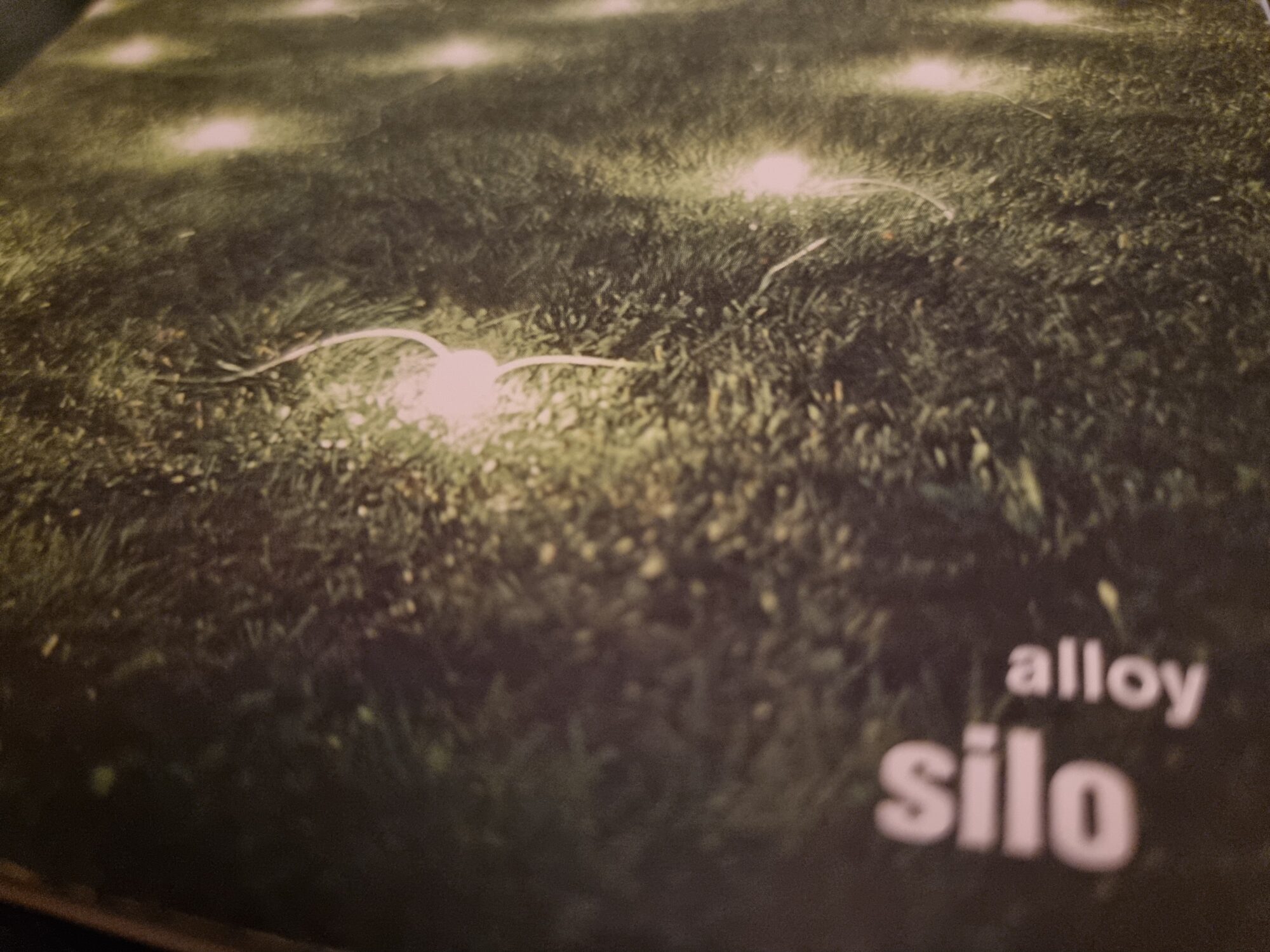
Future generations won’t know this moment: standing agog in a record shop clutching something you never thought you’d find. Staring in disbelief, initial shock gradually turning to gleeful laughter. Fellow customers edging away nervously.
Perhaps it’s something so rare that you couldn’t imagine laying hands on it. Perhaps it’s something you didn’t even know existed. Either way, that price sticker is a meaningless irrelevance; it’s sold, money no object.
I’m in Resident Records in Brighton, a couple of months ago. It’s a beautifully sunny, blustery day and we’re on a weekend break; I’ve got a voucher to spend. And I’m holding a new album by Silo, staring at it in disbelief, starting to laugh…
Nowadays, it’s pretty difficult to disappear from the radar entirely: Google shines light into the gloomiest corners, any discovery is shared instantly. But it’s been thirteen years since Danish trio Silo released two albums on the swim~ label run by Wire’s Colin Newman and Malka Spigel. An indication of just how long it’s been is that I can recall the thrill of finding that Silo had a MySpace page – status: “workinonit” – offering three tantalising clips of work in progress, proving that they still existed in some form. And then, year after year of silence.
There haven’t been many candlelit vigils, it’s true. But for a handful of us, Silo really mattered. For me, they were utterly pivotal: I continue to measure other bands against Silo, and I usually find those other bands sorely wanting. They were a benchmark, proof that certain things were possible, certain things were necessary. They were ‘alternative’ in the fullest sense: another species, another evolutionary path. No-one before and precious few since have managed to strike and hold such a perfect balance between rock music’s primal instincts and electronica’s obsession with architectural design. Very few have even bothered to try, something which perpetually disappoints me and yet does nothing to discredit the idea. This is not a band whose influence is far-reaching; this is a band whose research is unused.
Anyone can merge rock music with dance music. That’s easy. And rubbish, almost entirely. But Silo took no shortcuts at all: their sound remains resolutely fixed in guitar-bass-drums, even if it’s sometimes swelled by bass pulses and bleeps. There’s no mistaking them for anything other than a rock band, no attempt at dressing up in someone else’s clothes. There’s no cheating. Pretty much everything sounds familiar here; your first listen to Silo won’t make you recoil, and might well make you wonder what the hell I’m getting so excited about. But that’s the point: the building blocks are the same, the building isn’t.
I imagine that they began with a process of reduction. They took it upon themselves to strip away every last bit of catharsis, every shred of emotion and personality, and leave the bare skeleton of the metal bands they were listening to: Helmet, maybe Godflesh. And then they stripped it down some more, wiping away everything but the rhythm section: the foundation of any great rock band, the basis of all dance music, and the point at which the genres share their DNA. Nothing left but building blocks.
And then, they built something afresh with an engineers’s eye. With a laptop producer’s ingenuity and craft. Every track is a mechanism, created for its own sake, existing for no purpose other than to exist. Whirring, purring, throbbing. Every track is beautiful for that reason, for same reason as, say, Autechre’s best work is beautiful or, more recently, Logos’ sparse take on grime. And as fundamentally human as that too, as rooted in a simple desire to see what machines can do. They just did all of that with guitar-bass-drums, with samples of themselves rather than someone else; they just did it with rock music to see what would happen.
If all of that sounds rather dry and academic, then you just need to turn it up. Incredibly, for all of that formal experimentation, there’s no dilution of an essential aggression: this stuff rocks like an absolute bastard. No post-rock cop-outs here. It remains deeply physical music, robust and tangible, hefty and satisfying. And spectacularly well-suited to being played absurdly loud: particularly on 2001’s monumental “Alloy”, an increase in volume just brings you closer to the machinery, allows it to vibrate your chest and ruffle your hair; there are no serrated edges to make you wince, nothing which points outwards at all. Turn it up, let it close in around you. Become part of it.
They never belonged to a genre. The small group of swim~ acolytes and a few of the more forward-thinking Wire fans were as close as they came to being part of a scene. I’m struggling to think of any useful reference points: a post-digital Loop, perhaps, or Battles without all of the prog-rock doodling, but neither of those remotely do them justice. Their website profile mentions MBV and Band of Susans, Dalek and Helmet, J-Dilla and Sun-Ra…which are red-herrings too, unless they happen to inspire you to listen, in which case do carry on. They didn’t belong anywhere. They were a singular band, out on their own, inventing a future that no-one would live in. I’ve missed them every day.
Now, without warning, there’s a third Silo album, entitled “Work”. It turns out that the time elapsed since the last one hasn’t made them seem any less singular; there’s nothing remotely unusual about creating a rock record on a laptop these days, and yet they still seem just as wholly, fantastically, out of step with what everyone else is doing. Or everyone else is out of step with them. There’s always seemed to be something profoundly necessary about Silo, and I’ve found myself returning to “Work” over and over, just as I did with “Instar” and “Alloy”. It satisfies something distinct, a point at which I require something to get my head nodding and my brain working, something to punish and stimulate in equal measure. It isn’t like anything else.
It is, of course, very much like Silo. Opener “Filaments” fades gradually in as if it’s one of their perpetual motion mechanisms that’s been whirring away for the last thirteen years and has only just been recorded. Splendid closer “The Inexorable Sadness of Pencils” sounds similarly as if it might simply continue for ever, looping away in lovely, lop-sided orbits around itself until it drifts out of view. Except that it’s chopped short instead. The sound here is warmer and fuller and less brutal than on “Alloy”, and occasionally allows itself the luxury of a bit of gentle wah-wahing to fill in some of the spaces; I initially found that a bit irritating, I now find it rather pleasing. The only mis-step – perhaps their only mis-step, full-stop – is “O” with its cooing admiration of MBV, a rare and jarring moment when Silo sound like someone else, like people in pursuit of another band’s sound. They’ve no need.
Remarkably, the best moments are also the least plausible. Whoever thought of getting Anti-Pop Consortium in to rap energetically over a massive, shimmering riff on “Cabinn Fever” can’t possibly have imagined that it’d work as well as it does. It’s an unholy racket, the delinquent offspring of yesteryear’s neatly delineated rock-rap crossovers. Even better, and perhaps even more unlikely, is “Power Points”, which is turned by Maria Hamer-Jensen’s supple vocals into some kind of mutant R&B monster, just begging for a dancefloor to tear up. This is not a band content to circle endlessly around familiar ground, then, but one with fresh work to do.
As a fellow devotee has written, “they’d have been massively influential if anybody had actually heard them at the time”. With sadness, I’ve come to accept that Silo might not usher in a future in their image. On this evidence, I’m not at all sure that they have.
Ian Grant