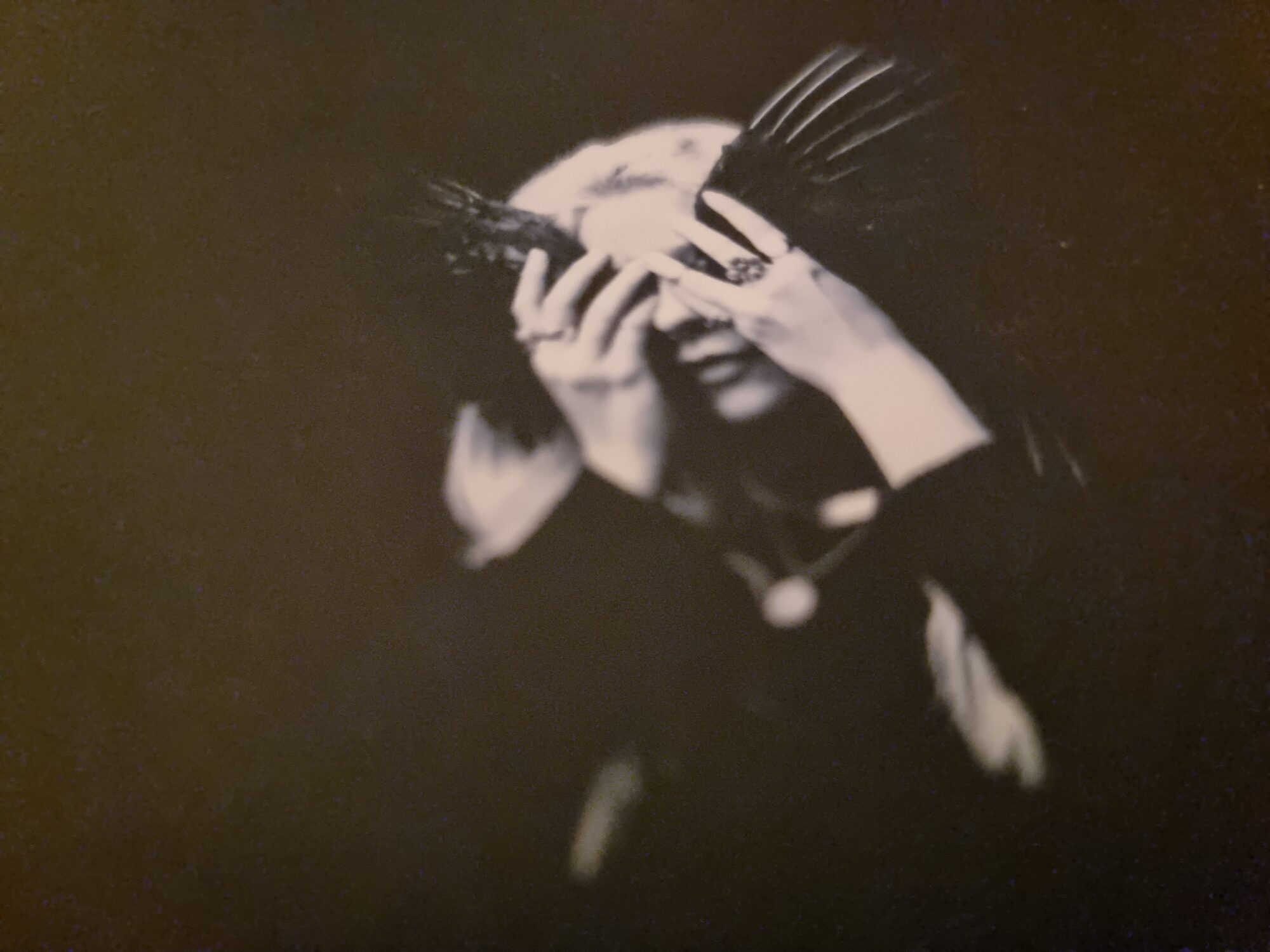
I’ve been thinking about “A Common Turn” a lot lately. It’s that kind of record. The more you listen to it, the more it becomes the place where your mind goes in idle moments, either to daydream or to find something to chew on. These days, my Bandcamp shopping cart usually contains an unaffordable number of things to which I can’t remember ever having listened, and as I sift through it all every Bandcamp Friday, I’m reminded of how easily my attention flits from record to record, of how little manages to hold me still. I hear more, but I listen less. In my youth, I could’ve sung every word of my favourite records; now, it’s going really well if I can remember what all of the songs are called. But I’m utterly captivated by this.
So captivated, in fact, that I find it quite hard to explain why you should listen to Anna B Savage’s debut album. I am Jonah and I’d like to tell you why you too should let yourself be swallowed by the whale. It isn’t even as if I have any points of comparison to offer you; I’m sure there are some, but my record collection doesn’t contain any of them, and besides, “A Common Turn” is such a singular piece of work, has such a life of its own, that there seems little worth in putting it next to other things.
Perhaps we should start with the voice, since your ears probably will. If you’re anything like me, and that record collection leans heavily towards understatement, under-elaboration and, perhaps, the limited vocal range favoured by Peel bands of a particular vintage, then Savage’s voice may present something of a hurdle. It is not the voice of someone hiding behind their fringe and staring at their shoes, nor is it drowned in reverb and lost somewhere in a cloud of swirliwhirliness. It is a bold, theatrical, ornate voice, and it dominates these ten songs.
I freely admit that I wondered if I’d be able to live with that voice for long periods of time. A long period of time being fifty-ish minutes, the duration of “A Common Turn”. As it transpires, that equation has been reversed: I find that I’m instead unable to live without it, and that I wouldn’t want to hear these songs sung in any other way. No, more than that: that they simply couldn’t be sung in any other way. They belong to that voice; it made them and it re-makes them every time you listen.
This is a searingly honest record, sometimes uncomfortably so. It is deeply personal too. It would be easy for it to feel as close and cramped as the confessional booth, or perhaps like being stuck in a lift with that acquaintance who’s always over-sharing on your Facebook feed, but there is instead so much space within its songs, so much to explore, that they become little worlds all of their own. That voice finds every corner of them, every nook and cranny. It brings out every nuance of some very fine lyrics. It invites you in, then lets you get lost.
After a few listens – and it does take more than one or two – you find that your head has been filled with its melodies. There are choruses, some memorable ones, but as with any great record, the verses are where it all really happens. Each line seems to extend for as long as it needs, as if it’s a train of thought on an idle summer’s day; sometimes we sit in the shadow of the line for a moment after it’s ended, not quite wanting the next one to begin. One idea, or one image, leads to another; there are stories and memories, but also contradictions, overlaps, arguments. For example, closing song “One” is musically sparse and spare, but lyrically drapes layers on top of each other, perfectly capturing a longing for resilience undermined by nagging insecurity. I’ve just looked at the words and it feels as if there ought to be twice as many lines as there actually are, for it covers so much so well.
It is not alone. The songs are full of references to music. Nick Drake and Leonard Cohen; memories of albums played in intimate moments; Tim Curry in lingerie as a masturbation fantasy. There’s an Edwin Collins owl mug, whatever the hell that is; it’s such a lovely phrase that I haven’t wanted to weigh it down with an actual object by putting it into Google. All of that personal detail, the clutter of someone’s life being lived, makes it feel as if everyone else has been bleaching their songs clean. It makes you wonder why other musicians – who presumably also like music, or at least once did – have stripped all of this stuff away, perhaps in service of a kind of bland universality.
The details are the life of these songs. They make “Baby Grand” feel as if it’s the first song that’s ever been written about a crisis of uncertainty over someone’s affections…which, just in case you’ve never actually heard any pop music, it isn’t. If not the first, then at least one of the best: in so vividly portraying a single evening, in paring away any generalisation and leaving just her own experience, Savage invites you to remember your own equivalent, and the two become fused together. The details make the chorus of “BedStuy” and its image of holding hands on the subway home, trying not to fall asleep, seem profound and monumental, aided by a swelling electro pulse overtaking the acoustic backing as if a memory is engulfing more present thought. They enable “A Common Tern” to capture the loneliness of a relationship breakup, the quiet retreat away from togetherness, while ostensibly talking about birdwatching. There are a lot of birds: corncrakes, swallows, doves, terns. There is so much that’s alive here.
You may have noted that I haven’t written much about the music, perhaps concluded that it must be rather incidental. Thing is, Savage and producer William Doyle, whose glorious “Your Wilderness Revisited” album sat atop my end-of-year list for whenever-it-was, have between them created music which understands instinctively when to step forward and when to step back, when to fiddle and when to leave alone, when to demand and when to give. By ‘instinctively’, I mean that it feels instantly right in each moment of these songs, responds to them as if hearing their meaning without needing to be guided. The hard work and the ambition are evident throughout, for there is little here that’s simple even when it seems so, but they never drag anything down. There’s a remarkable amount of economy in what often appear to be quite elaborate arrangements.
And of course, the voice responds in turn. Some of these songs have a romantic streak a mile wide, even if that romantic streak is finding life somewhat bitter to the taste, and sometimes they need to throw their arms wide and their head back and soar. In those moments – the sudden electro of “BedStuy”, previously mentioned; the stuttering pop of “Two”; the driving guitar of “A Common Tern” – Savage glides over the top, commanding and irresistible, momentary pop star. In other moments, all of it is reined right in and we have nothing but bare bones. “One” recounts a tale of an escaped fling with someone who “said my body was sh…/Didn’t like the look of it”, and the censorship is hers, and the last syllable of that second line is crisply enunciated with such feeling, with such a pent-up force of hurt and pride, that it almost splits clean in two.
And still I don’t think I’ve captured it all, but I should leave things for you to find. Not having my finger very firmly on the pulse nowadays, I’ve no idea how many people will hear and buy this record. Not enough, I imagine, although rather more than magnificent self-doubt anthem “Dead Pursuits” suggests with its chorus of “Is anyone listening?” It strikes me as being something that a small but not insignificant number of people will care about very deeply for a very long time. I’m a fifty year old straight white bloke who grew up in suburban Watford and I appreciate that nobody urgently needs to hear my truth, but there’s something incredibly inspiring and empowering about it nevertheless.
There’s a beacon being lit here, for a certain type of person, for a certain type of life. Yes, that kind of record. The best kind. I hope it’s heard by everyone who needs to hear it, that it inspires and empowers them too, that it’s treasured as fervently as it deserves to be treasured. It’s a beautiful piece of work.
Ian Grant